Maintaining a regular workout routine is key to staying healthy. For some people, a workout routine could mean taking daily walks and going for bike rides around town, for others it means HIIT workouts three times a week and some energizing fitness classes at Club Studio.
Wherever you land on the workout spectrum, it’s crucial to ensure your routine isn’t damaging your hearing. Let’s look at two common sources of loud noise during workouts and how you can protect your ears.
1. Headphone Use
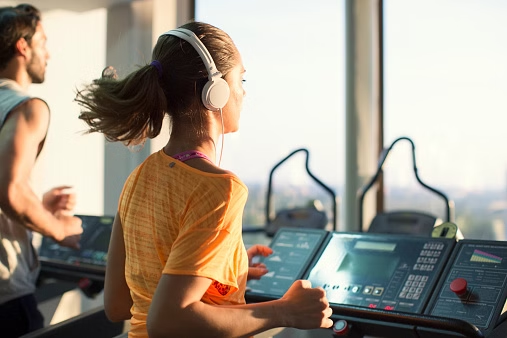
A 2025 study on headphone use found that many commercially available headphones and earphones can reach sound levels exceeding 125 decibels (dB)[1]—that’s past the threshold for immediate hearing damage.
When you’re on a run or at the gym, you might turn your music or podcast up higher than is safe, especially if your background is noisy and your headphones don’t have noise-cancellation features.
To protect your hearing, set a decibel limit in your phone’s “headphone safety” settings of no more than 80 dB. Switching from earbuds to over-the-ear, noise-canceling headphones will allow you to listen to your music at a much safer volume.
2. Fitness Class Music
Anybody who’s ever taken a cycling or dance class knows that the music can get pretty loud. A 2026 study following participants in 1-hour fitness classes found a mean volume of 91.4 A-weighted decibels (dBA) for louder classes and 88.5 dBA for quieter classes.[2] Any sound over 85 dB can cause hearing loss. The study recommended implementing safe listening practices in fitness classes.
Your fitness classes may exceed the levels examined in the study. A good rule of thumb is that if the sound feels too loud (like it’s uncomfortable) or causes ringing in the ears, it’s a good idea to wear earplugs to reduce the volume. You can choose lightweight earplugs that reduce the volume to a safe level while still letting you hear the instructor’s voice.
If you spend a lot of time in noisy fitness classes or have a bad habit of playing your music too loudly, contact Hearing Center Silver Spring to schedule a hearing test with one of our specialists.
[1] Kaur, G., Anand, A., Chakraborty, P., Pravin, T., Khalilullah, M., Tarafdar, R., Raj, D., & Mukherjee, S. (2025). Use of Headphones and Its Impact on Hearing: A Cross-Sectional Survey of Medical, Nursing, and Pharmacy Students. Cureus, 17(11), e96900. https://doi.org/10.7759/cureus.96900
[2] Hori, K., Wee, C. P., Liu, N., Parsons, J., & Choi, J. S. (2026). Lower Music Volume Levels in Fitness Class and Perceived Exercise Intensity. JAMA otolaryngology– head & neck surgery, 152(5), 465–471. https://doi.org/10.1001/jamaoto.2026.0028